AgentCore course → Lesson 1
Translating what you already know
You know agentic systems. So don't learn it from scratch. Work out which of the things you currently hand-build it takes off you, and which stay yours.
Start from what you have
You've built or reviewed agents with LangGraph, CrewAI, and MCP tooling. You know what an agent loop is, what a tool call costs you in reliability, and how quickly state management becomes the hard part. Hold all of that. This lesson only adds a map.
The reframe that decides every later conversation
The most common mistake in an AgentCore conversation, made by customers and SAs alike, is treating it as a competitor to the framework the customer already uses. It isn't. AgentCore is deliberately framework-neutral: AWS documents support for CrewAI, LangGraph, LlamaIndex, Google ADK, the OpenAI Agents SDK, Strands, and custom frameworks, with any model in or outside Bedrock, and with MCP and A2A as first-class protocols.Framework, model, and protocol support per the AgentCore Developer Guide overview. Retrieved 2026-08-05.
That neutrality is a deliberate bet: that the durable, hard, undifferentiated work in agentic systems isn't the reasoning loop but everything around it. So the question to put to a founder is never "AgentCore or LangGraph." It is:
The one idea
AgentCore is the operational substrate beneath your agent framework, not a replacement beside it. The real question is which parts of your current plumbing you are willing to stop building yourself.
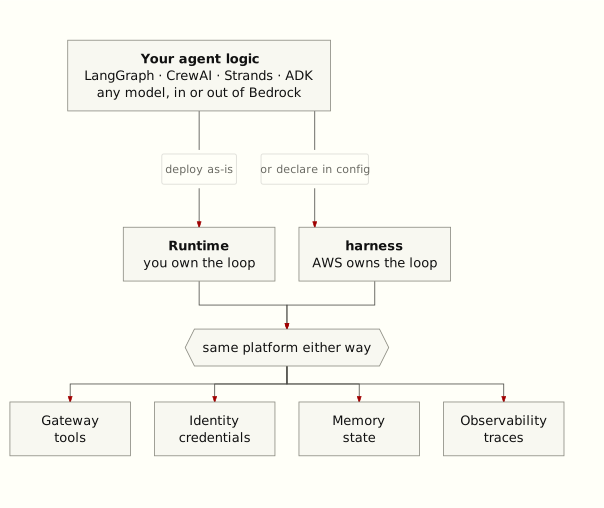
What you stop building
This table is the lesson. Read it as a list of things a startup engineering team currently maintains, and what AgentCore offers in place of each.
| What you hand-build today | AgentCore capability | What actually changes |
|---|---|---|
| Checkpointer or state store for conversation history | Memory | Short-term for multi-turn, long-term persisting across sessions, and stores shareable between agents |
| Tool registry, API wrappers, hand-rolled MCP shims | Gateway | APIs, Lambda functions, and existing MCP servers become governed MCP tools; large catalogs get semantic search |
| Secrets handling and per-user token exchange | Identity | Works with your existing IdP (Cognito, Okta, Entra ID, Auth0) with no user migration |
| Sandboxed code execution for the agent's own output | Code Interpreter | Isolated sandbox; Python, JavaScript, TypeScript |
| A headless browser fleet you keep patched | Browser | Managed cloud browser runtime; works with Playwright and Browser Use |
| Span instrumentation and trace export | Observability | OpenTelemetry-native, so it lands in whatever stack the customer already has |
| Container platform, autoscaling, session isolation | Runtime | Serverless, with genuine per-session isolation and built-in identity |
| The agent loop itself | harness GA | Optional. Declare model, tools, skills, and instructions in configuration and AWS assembles the loop |
Every one of these is independently adoptable. AWS's own framing is that the capabilities "work together or independently."Modularity and per-capability independence, AgentCore FAQs. Retrieved 2026-08-05. That matters commercially more than it sounds: a startup can take Gateway alone and keep everything else, which makes the first conversation much easier than an all-or-nothing platform pitch.
What stays yours
Worth being just as clear about, because it is what reassures a technical founder: your agent logic and graph structure, your prompts, your model choice, your business rules, and your evaluation criteria. AgentCore does not ask for any of them.
The one fork that matters: Runtime or harness
If you remember one distinction from this lesson, make it this one. It is the thing customers get wrong most often, and the two names do not help.
Runtime: you own the loop
You wrote the agent. Maybe it is a LangGraph graph or a CrewAI crew. Runtime is serverless compute purpose-built to host it: fast cold starts, per-session isolation, long-running async support, MCP and A2A.
Reach for it when the customer already has working agent code, or needs orchestration you cannot express in configuration.
harness: AWS owns the loop
You did not write an agent loop at all. You declared one: model, tools, skills, instructions. AWS assembles and runs it. Each session gets its own isolated environment with a filesystem and shell.
Reach for it when the customer is starting fresh, or prototyping, and does not want to own orchestration code.
AWS's own metaphor for the harness is worth borrowing verbatim in a meeting, because it lands quickly: if the model is the brain, the harness is the body. It runs the orchestration loop, executes tools, manages the context window, persists state across turns, recovers from failures, and isolates each session.The brain-and-body framing, and the export-to-code path, from AgentCore harness is now generally available, 17 June 2026. Retrieved 2026-08-05.
Two properties of harness are worth knowing now, because they pre-empt objections you will hear in Lesson 6. It's decoupled from the model, so you can switch model providers mid-session without losing context, for instance planning with one model and writing code with another. And it's not a one-way door: a single CLI command exports the harness orchestration to Strands-based code, running on the same compute and the same primitives, with the Claude Agent SDK named as a future export target.
Say this to a customer"You don't have to choose between LangGraph and AgentCore. AgentCore runs underneath it. Start with whichever single piece hurts most today. If that's tool access and credentials, start with Gateway and Identity and change nothing else."
Don't overclaim
AWS describes Runtime as having "fast cold starts" but publishes no latency figure, and documents "extended runtime support for asynchronous agents" without stating a ceiling. If a founder asks for numbers, say they aren't published and offer to get them. Don't estimate. Guessing here is how you lose a room of engineers.
Read this next: 10 minutes, highest value
AgentCore Developer Guide: Overview
The single canonical page: every capability with a one-paragraph description and, crucially, the framework and model integrations for each. If you read one AWS page before your next customer meeting, read this one. Skim the capability table and note which names surprise you. Retrieved 2026-08-05.
Retrieval practice
Answer from memory, without scrolling back. Getting one wrong here is more useful than getting it right by looking.
-
A LangGraph app keeps conversation state in a checkpointer backed by Postgres. Which AgentCore capability replaces it?
Answer: B (Memory).
-
A team has a working CrewAI crew and wants it deployed without rewriting it. Which is the fit?
Answer: B (Runtime).
-
A founder says "we already use LangGraph, so AgentCore isn't for us." What is the accurate reply?
Answer: B. It runs beneath, and keeps LangGraph in place.
Where to go next
Lesson 2 takes the fork in Figure 1 seriously: how to choose between Runtime,
harness, Lambda, and ECS or EKS, what session isolation actually buys, and what
runs in ca-central-1. That last part matters most for your customers
specifically.
Two reference cards support this lesson: the terminology card, for AgentCore's genuinely confusable names, and later the service map, for maturity and region footprint at a glance.
Questions to take forward
- Role-play a sceptical founder who thinks AgentCore is lock-in, and see whether my answer survives it.
- Go deeper on any single row of the mapping table.
- Come at the Runtime/harness distinction from a different angle if it still feels slippery — a different angle, not a repeat.